
In understanding the importance employees to ‘get’ his vision, Mothobi emphasized the need for an effective and thoughtful selection process that not only values experience and excellence, but also deep self-awareness and mastery.
He passionately states,
“I want to ‘get’ the person, I want us find each other. I challenge the person to dig into themselves, his pain, motivation, and what really drives him”.
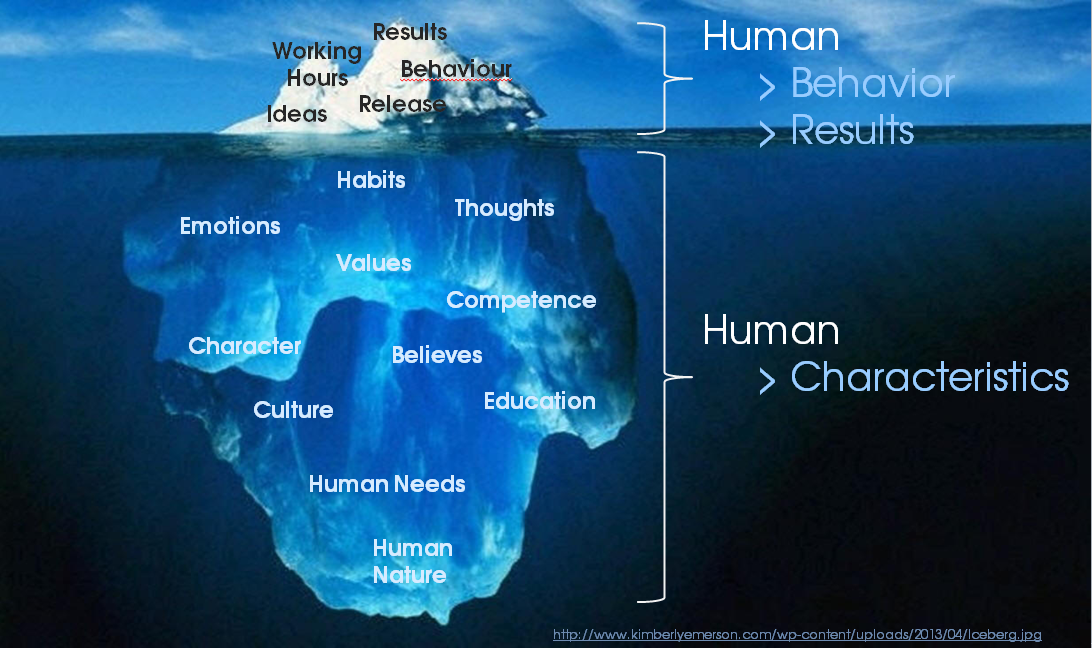
This reminded me of the Iceberg model of human behavior that argues that what we see and hear from humans is only about 20% of an 80% deep rooted concept of self. Below is one of the many iterations of the model.
Mothobi and I further spoke about how culture is an inescapable element of the behaviour we see in our organizational spaces. “But is there still space of an ubuntu culture in business today ?”, I asked. The answer was multifaceted. On one level, in the capitalist environment we live in, it is not easy to create an ubuntu type of system. On another level, we spoke about how some societal spaces are more open to ubuntu than others. And on an embodied level, I found Mothobi’s approach about the people in his organization quite humanistic and valuing of self-dignity. These are core elements of ubuntu. Our time with Mothobi also resembled a stimulating conversation with a wise uncle who respected your point of view and shared a glass of Cape Town’s finest wine with you. This made me think, has ubuntu evolved with time?